Summary

In this unit, students use, compare, and develop scientific models to investigate scientific questions, such as where a species is likely to be found in the future. They explore how data on ecological change is gathered and how scientists use different methods of population estimation, such as Fermi estimates, to simplify complex problems and guide research. They apply their new skills to deciding on a scientific question, constructing a model, and determining the most important factors to include in a model (known as orders of understanding). Throughout the unit, students apply these conceptual tools to local and global ecological issues.
Unit Driving Question
How can scientific models be used to investigate changes in the distribution of species?
A rough understanding that captures the most significant features of a system or phenomenon has great utility, and is often sufficient. Students need to be able to identify the most significant features, causes, etc. of a system, especially in situations with many causes of widely varying effect sizes.
Teacher Edition
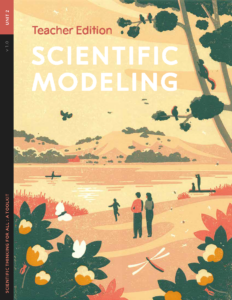
The teacher edition is designed to support teachers in fostering student learning over the entire unit. Information provided includes day-to-day instructional management: how to prepare the classroom, what materials are needed, sample student responses, and how to modify materials for diverse learners.
Teacher edition, Unit 2: Scientific Modeling (3.3MB)
Student Book
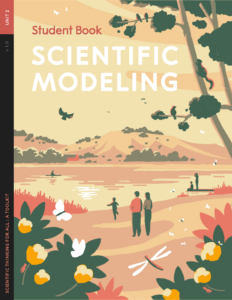
Each unit requires students to interact with specific key concepts, process skills and thinking tools through various learning experiences. The student book has a deliberate structure that provides support for student learning, regardless of activity type.
Student book, Unit 2: Scientific Modeling (9.7MB)
Activities
Using Models
Activity Type: Card-Based InvestigationNumber of 40-50 minutes class periods: 2
How can models be used to inform a decision?
Download Activity (Teacher Edition)
Download Activity (Student Book)
Scientific Models and Scientific Questions
Activity Type: Data AnalysisNumber of 40-50 minutes class periods: 2-3
How are scientific models used to answer scientific questions?
Download Activity (Teacher Edition)
Download Activity (Student Book)

Constructing a Model
Activity Type: Field TripNumber of 40-50 minutes
class periods: 2-3
How are firsthand observations used in scientific modeling?
Download Activity (Teacher Edition)
Download Activity (Student Book)

Modeling Factors Affecting a Population
Activity Type: Computer SimulationNumber of 40-50 minutes class periods: 1-2
What factors should be included in a scientific model?
Download Activity (Teacher Edition)
Download Activity (Student Book)
The Role of Models in Science
Activity Type: ReadingNumber of 40-50 minutes class periods: 1
How do scientific models represent a system?
Download Activity (Teacher Edition)
Download Activity (Student Book)

Modeling Migration
Activity Type: InvestigationNumber of 40-50 minutes class periods: 2-3
How can models include uncertainty?
Download Activity (Teacher Edition)
Download Activity (Student Book)

Fermi Estimations
Activity Type: Data AnalysisNumber of 40-50 minutes class periods: 2
How can you use mathematical modeling to make an estimate?
Download Activity (Teacher Edition)
Download Activity (Student Book)

Modeling a Method
Activity Type: InvestigationNumber of 40-50 minutes class periods: 2
How can you revise a model for estimating population size?
Download Activity (Teacher Edition)
Download Activity (Student Book)

Constructing Predictive Models
Activity Type: PresentationNumber of 40-50 minutes class periods: 1-2
How can a model be used to predict changes to the distribution of a population?
Download Activity (Teacher Edition)
Download Activity (Student Book)
Applying Models to Decisions
Activity Type: Card-based InvestigationNumber of 40-50 minutes class periods: 2-3
What role can models play in making a conservation decision?
Download Activity (Teacher Edition)
Download Activity (Student Book)


